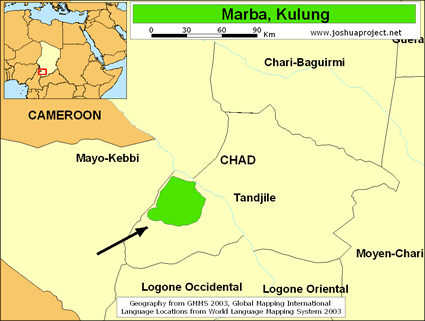
The Marba, sometimes referred to locally as Kulung or Azumeina, are an ethnic people of southwestern Chad whose identity is closely tied to the Marba (Azumeina) language, a member of the Afro-Asiatic, Chadic language family. Their traditional homeland lies in the fertile plains and riverine landscapes of the Tandjilé and Mayo-Kébbi Est regions of Chad, where extended families and clans have lived for generations. The Marba language carries the stories, oral traditions, and cultural frameworks that link present-day communities with their ancestors and the rhythms of village life. Linguistic research identifies the language as part of a broader Masa subgroup within the Chadic branch, reflecting deep historical roots in this part of Central Africa.
Daily life among the Marba is grounded in strong family and community relationships that shape social rhythms and shared responsibilities. Farming, fishing in local waterways, and tending livestock are central to subsistence, with gardens providing staples that sustain households. Extended families cooperate in planting, harvesting, and preparing food, and communal exchange and celebration reinforce bonds across age groups and villages. While French is an official language of Chad used in formal settings, many Marba also use regional lingua francas such as Sara, Kanembu, or Chadian Arabic in broader trade and communication, while the Marba language itself remains a key marker of identity and cultural continuity. Literary efforts, including standardized written forms of the language used in some schools and community initiatives, reflect ongoing engagement with cultural heritage.
Christianity is the primary faith for many Marba people, and churches are present in numerous communities, shaping worship, fellowship, and moral teaching. Scripture, including the complete Bible, is available in the Marba language, supporting both personal reading and corporate worship in a language they understand. Audio recordings, evangelistic media, and translated gospel resources further support local engagement with biblical teaching. Traditional beliefs and respect for ancestors remain part of cultural memory and may influence personal perspectives for some individuals, but for many today Christian faith provides the main lens through which life and community values are understood and expressed.
Marba believers benefit from continued encouragement in spiritual growth and discipleship that is anchored in scripture and expressed in their own cultural context. Strengthening church leadership through biblical training, mentorship, and culturally relevant teaching resources can help pastors and teachers serve with wisdom and humility. Families and youth especially benefit from opportunities that connect Christian faith with daily life and local tradition, helping the next generation grow in spiritual maturity. Bible engagement, discipleship materials, and fellowship that nurture resilience and unity within and among villages can help deepen community faith.
Pray that Marba Christians would grow in love for Christ and in understanding of scripture.
Pray for pastors and church leaders to lead with humility, wisdom, and a heart for service.
Pray for families to be strengthened in faith, unity, and compassion, with children and youth nurtured in Christ-centered values.
Pray for vibrant engagement with Scripture in the Marba language, bringing insight, transformation, and hope to individuals and communities.
Pray that the Marba would have a clear and gracious vision to share the hope of Christ with neighboring peoples in ways that honor cultural identity and reflect Christ-like compassion.
Scripture Prayers for the Marba, Kulung in Chad.
https://en.wikipedia.org/wiki/Marba_language
https://www.ethnologue.com/language/mpg
https://dbs.org/en/research/languages/mpg
https://megavoice.com/media-cloud/m0b4785-words-of-life-1-mpg-marba-azoumeina-audio-bible/
| Profile Source: Joshua Project |